
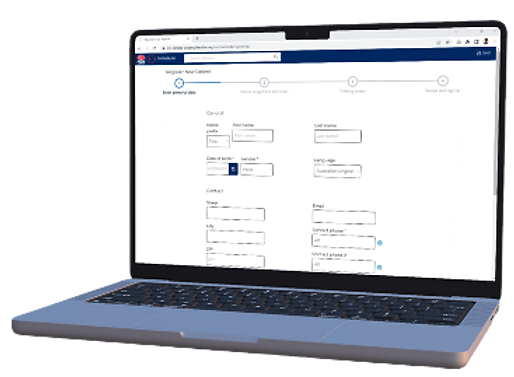
Remote patient monitoring only works if someone is accountable at every point between “the patient went home” and “the patient is stable.” That’s the design principle behind TCC’s patient journey: five stages, each with a clear owner, so nothing depends on a patient remembering to flag a problem themselves.
1. Referral
A patient enters the program through their treating team — either directly from an EMR referral or via an outpatient pathway. This is the only manual step in the journey; everything after it is built to run without anyone having to chase paperwork.
2. Onboarding
Devices are provisioned and the TCC Patient App is paired to the patient’s phone. Depending on the condition being monitored, this might mean a blood pressure monitor, digital scales, a pulse oximeter, or a blood glucose meter — all TGA-approved peripherals, all designed to work over Bluetooth with minimal setup. Most patients are onboarded in a single visit.
3. Monitoring
This is where the daily rhythm of the program lives. Patients record biometrics through their paired devices and answer a short set of condition-specific questions in the app — a few minutes a day, from home. No manual data entry, no phone calls to relay numbers.
4. Management
Every reading is checked against condition-specific thresholds by the Alert Management System. When something crosses a threshold, it’s flagged for clinical review — not buried in a dashboard someone has to remember to check. This is the stage that turns monitoring into intervention:
“See a patient deteriorating — before they do.”
That’s not a slogan. It’s the actual design brief for this stage of the journey.
5. Support
The clinical team acts on what Management surfaces — adjusting care, reaching out to the patient, or escalating — and the loop closes. The patient stays in Monitoring, and the cycle continues for as long as the referral requires.
Why the stages matter more than the technology
It would be easy to describe TCC as “an app with some Bluetooth devices attached.” What actually makes it work is that each of these five stages has a defined owner and a clear handoff to the next one. A remote monitoring program that can’t say who’s responsible at 2am on a Sunday isn’t really a monitoring program — it’s a data collection exercise.
If you want to see how this looks in the TCC Clinical Care dashboard, the platform pages walk through the alert model in more detail.